
From Policy to Protection: Bringing Workplace Violence Toolkit to Life

Summary of ASHRM – (American Society for Healthcare Risk Management) Toolkit:

ASHRM’s Workplace Violence Toolkit (April 2023) gives healthcare leaders a roadmap to address one of the sector’s most pressing risks: violence against staff. It highlights the full spectrum of incidents—from verbal abuse to physical assault—and provides practical tools such as readiness surveys, prevention checklists, and response protocols across five risk areas (patient, visitor, staff, physician/third-party, and stranger). The message is clear: safety must be a system-wide priority, not an afterthought.
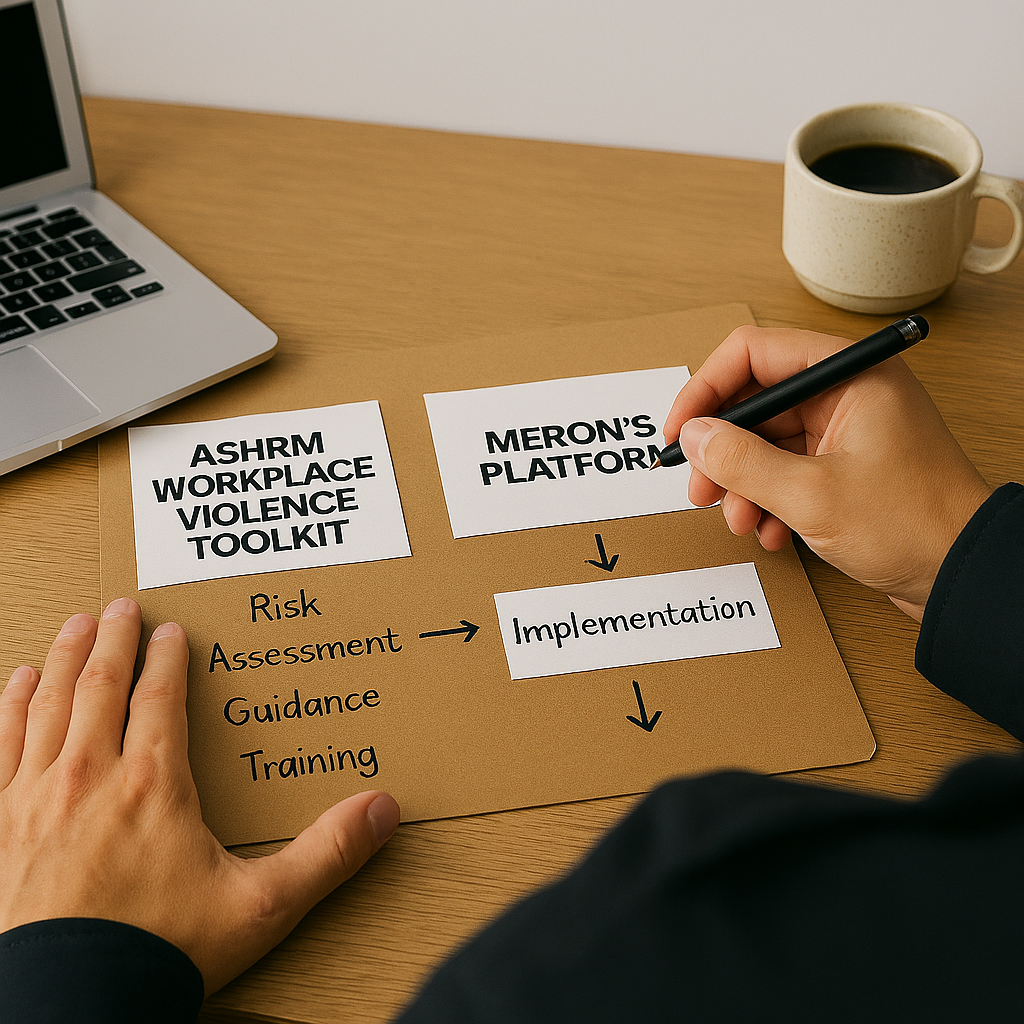
Where Meron Delivers Impact:

While the toolkit sets the standard, Meron helps organizations put it into practice. Our PIAM+ platform strengthens workplace safety by:

  • Detecting risks early through behavior and incident pattern recognition.
  • Guiding rapid response with automated alerts and playbooks aligned to ASHRM’s framework.
  • Empowering leaders with dashboards that mirror readiness surveys and show progress in real time.
  • Reinforcing culture by tracking compliance, safety training, and staff engagement

Top Use Cases for Meron PIAM+ in Healthcare (Aligned to ASHRM Toolkit)

  • Why it matters: Many workplace violence incidents begin when patients, visitors, or unauthorized staff gain access to restricted zones (ER back corridors, behavioral health units, med rooms).
  • Meron impact: Real-time identity validation + access control ensures only credentialed staff enter. Visitor badges, biometric wearable integrations, and zone-based restrictions prevent “tailgating” or badge misuse.
  • Value: Reduces risk of aggression in sensitive areas, strengthens compliance (HIPAA, Joint Commission).
  • Why it matters: Visitors/family are one of ASHRM’s five high-risk violence categories. Hospitals often lack robust pre-screening or tracking.
  • Meron impact:
    • Pre-register visitors with background and compliance checks.
    • Flag high-risk visitors (e.g., prior incidents, protective orders, External National Databases).
    • Real-time alerts if flagged individuals attempt entry.
  • Value: Reduces risk of aggression in sensitive areas, strengthens compliance (HIPAA, Joint Commission).
  • Why it matters: ASHRM emphasizes leadership readiness surveys and workforce preparedness. Yet tracking training is often manual and fragmented.
  • Meron impact: Centralized “single pane of glass” for staff certifications, workplace violence training, and compliance status. Automatic alerts for expired credentials or missed training.
  • Value: Ensures every staff member is trained and ready, with a verifiable audit trail.
  • Why it matters: Many violent or disruptive incidents go underreported due to manual, slow processes. ASHRM urges proactive & reactive workflows.
  • Meron.ai impact: Mobile-friendly incident capture (app, kiosk, video intercom) feeds into automated workflows: security alert, HR notification, and response playbooks.
  • Value: Faster intervention, better data capture, trend analysis for prevention.
  • Why it matters: Early signals—escalating patient behavior, repeated visitor complaints, staff bullying—are often missed.
  • Meron impact: AI-driven monitoring across access logs, incident history, and communications to flag emerging risks.
  • Value: “See it before it happens” – a direct extension of ASHRM’s prevention-first model.
  • Why it matters: In violent events, confusion slows response.
  • Meron impact:
    • Automated lockdowns for specific zones.
    • Mass notification to staff and security.
    • Real-time location of staff, assets, and responders.
  • Value: Faster, coordinated response → reduced harm, lower liability.
  • Why it matters: ASHRM stresses the role of leadership in culture and readiness. Executives often lack visibility into frontline safety metrics.
  • Meron impact: Consolidated Dashboards showing –
    • Training compliance by department.
    • Incident heatmaps.
    • Visitor traffic and flagged cases.
    • Credentialing gaps
  • Value: Reduces risk of aggression in sensitive areas, strengthens compliance (HIPAA, Joint Commission).